
Stand under the famous chandeliers at the IXL Events Centre at Stoneleigh, put a few hundred of Coventry and Warwickshire’s sharpest business leaders in a room, and the real state of the UK economy becomes crystal clear within ten minutes.
On Friday, Glenn attended the Coventry and Warwickshire Chamber of Commerce’s 26th Annual Business and Economic Conference held immediately after the Chamber’s 123rd AGM. Group Chief Executive Corin Crane set a brilliant, human tone from the off, getting the entire auditorium to wave for a photograph to cheer up his mum, before thanking the regional heavyweights backing the event: headline sponsor Prime Accountants Group, supporting sponsors People Arches, HCR Law, and Coventry City Council, AGM sponsor Coventry and Warwickshire Reinvestment Trust (CWRT), and host venue partner IXL Events Centre.
Across four hours of hard economic data, candour from the coalface, and battle-tested founder stories, a single, glaring paradox emerged.
Midlands business owners have no shortage of ambition. Yet across the country, boardrooms are locked in a defensive crouch. We call this The 17% Trap.
As Shevaun Haviland CBE, Director General of the British Chambers of Commerce (BCC), revealed in her “State of the Nation” address, business confidence ticked up by three points in the latest Quarterly Economic Survey of 5,000 private sector firms. However, only 17% of UK businesses plan to increase investment over the next twelve months.
Instead of deploying capital to capture market share, fix productivity bottlenecks, or build transferable enterprise value, 83% of businesses are sitting on their hands, hoarding cash on their balance sheets, and waiting to see what cost shock comes around the corner next.
Having bootstrapped and scaled businesses from startup to £20m+ turnover exits, we can tell you this with absolute certainty: you cannot shrink, hoard, or wait your way to a high-multiple exit.
Here is our executive debrief, unpacking the real macroeconomic headwinds facing mid-market operators, why your current AI “strategy” is likely just laying AstroTurf on a swamp, how to pivot your core capabilities when your primary sector contracts, and the specific levers you must pull this quarter to drive your EBITDA and valuation upward.

1. The 17% Investment Paralysis: Treading Through Treacle
Why are so many capable founders freezing their capital expenditure right now? Because the operational friction of running a British business has reached a ten-year high.
Eleanor Deeley, Joint Managing Director of the 90-year-old Coventry contractor and developer Deeley Group, summed up the mood of the mid-market on the morning panel: operating right now feels like “treading through treacle.” Every project faces repeated viability hurdles, planning delays, and shifting goalposts before a single spade hits the ground.
Shevaun Haviland backed up that boardroom frustration with stark data from the BCC’s research:
- The 70% Policy Cost Surge: Over the past decade, the cost of doing business in the UK has risen by more than 70%, driven by government policy costs alone.
- The Triple Margin Squeeze: Currently, 70% of firms cite labour costs as their biggest price pressure, 60% point to inflation, and over 50% are being squeezed by utility and energy bills.
- The Defensive Mindset: Instead of asking “Where can I invest next?”, founders are trapped asking “What cost is coming next?”
On the panel alongside Eleanor, Steve Harcourt, Director at Prime Accountants Group, confirmed what we see across the Midlands every week: confidence is fragile and patchy, and there is a vast amount of cash sitting idle on company balance sheets. Atul Lakhani, Chief Executive of the IXL Events Centre and a 25-year hospitality veteran across Leicestershire and Warwickshire, pointed out the perverse disincentives built into the current tax and business rates regime. While the pandemic stripped hospitality businesses of their financial reserves, Brexit stripped them of their manpower. Layer on lowered National Insurance thresholds and a rateable system linked to turnover, and many operators feel penalised for growing their top line while their net margins are being eroded.
The Macro Horizon: Why Waiting for Westminster is a Fool’s Errand
If your strategy for 2027 is waiting for the government or the Bank of England to make your life easier, Emma Wilks, UK Economist at HSBC UK, delivered a sobering reality check.
While financial markets gave the Chancellor’s recent Autumn Budget a pass mark for being a “keep calm and carry on” exercise that calmed gilt yields, Emma noted that its 98 individual policy measures did virtually nothing to improve the UK’s medium-term growth outlook. Worse, the difficult fiscal arithmetic has simply been kicked down the road to the 2027 Spending Review. With the government pencilling in unrealistic post-2029 public spending cuts and making an unfunded commitment to raise defence spending to 3% of GDP, a massive fiscal hole remains. Taxes, borrowing, and spending are all trending higher, leaving the UK economy vulnerable to future shocks.
For mid-market leaders building their 2027 and 2028 budgets, Emma highlighted three specific operational pressures you must price into your forecasts immediately:
- The 96% Refinery Bottleneck (Diesel and Logistics): While global crude oil flows remain relatively healthy despite US-Iran tensions (with HSBC forecasting a global oil oversupply next year), the real pinch point is in refined products like diesel and jet fuel. Global refineries are currently running at a 96% utilisation rate. Because capacity is maxed out, diesel and distribution costs will remain under severe upward pressure for the next 18 months, regardless of what happens to crude oil prices.
- The 4.8% Inflation Peak and Interest Rate Friction: Driven by this energy shock, inflation is forecast to peak around 4.8% before falling back toward 2% in early 2028. Because businesses can no longer absorb these costs in their margins and are passing them through to prices, the Bank of England (led by Governor Andrew Bailey) hiked interest rates on Thursday and signalled another hike is possible. While the Bank of England wants wage growth at or below 3.3% to keep domestic inflation at 2%, UK wage growth is currently running hot at 4%.
- The B2C Consumer Drag: Households represent 60% of the UK economy, and their cash buffers are exhausted. Between 30% and 35% of UK households now have less than £1,000 in cash savings, credit card defaults are ticking upward, and the Office for Budget Responsibility (OBR) forecasts a decline in real household disposable income across both 2027 and 2028, capping off a “lost decade” for consumer spending power.
The Cameron & Cameron Rub: Speed is Success
When you look at those numbers, it is easy to see why 83% of businesses are hoarding cash.
But here is the hard truth of corporate valuation: lazy cash on a balance sheet does not drive your exit multiple. Acquirers and private equity investors do not pay a premium for a business that has gone into hibernation. They pay a premium for resilient, systemised, growing EBITDA.
Eleanor Deeley delivered the standout quote of the morning panel when she said: “For SMEs in particular, speed is success. The quicker we can deliver, the more success we have.”
While Westminster moves at a glacial pace, mid-market founders have the ultimate competitive advantage: agility. If four out of five of your competitors are freezing their budgets, delaying upgrades, and retreating into their shells, the market is wide open for the 17% who invest strategically to strip out unit costs and capture market share.

2. Stop Laying AstroTurf on a Swamp: The AI Reality Check
If there was one topic that dominated every coffee break, panel, and lunch conversation at the conference, it was Artificial Intelligence.
Emma Wilks shared a staggering macroeconomic statistic from HSBC’s analysis: AI investment alone has contributed roughly 40% of the UK’s entire economic growth so far this year. Yet when you look beneath the bonnet, only 35% of UK businesses are actually adopting AI, and only half of those (around 17.5%) are paying for commercial AI tools. The vast majority are simply tinkering at the edges with free browser tools.
In the afternoon session, Professor Elena Gaura, Associate Pro Vice-Chancellor for Research and Chief AI Officer for the Coventry University Group (an enterprise with 4,000 staff, 40,000 students, and 28 subsidiaries), delivered a masterclass on why so many early AI adopters are failing to see a return on investment.
Her warning to the room was blunt: “Doing nothing is not an option.” However, jumping in without a commercial target is equally fatal. Her golden rule is “Purpose first, technology second.”
When founders put technology first because they are terrified of missing out, they make two expensive mistakes:
- They buy complex, expensive agentic AI platforms to solve a problem that could have been fixed with basic, low-cost process automation.
- They end up “laying AstroTurf on a swamp.”
In almost every mid-market business we work with, “the swamp” is poor data quality: customer records scattered across disconnected spreadsheets, data you assume you have but do not actually capture, and broken operational workflows. If you layer an AI tool on top of a broken process, you do not get efficiency; you just generate chaos at ten times the speed.
The 4 Pillars of Purposeful AI (and the Productivity Trap)
Professor Gaura exposed one of the biggest fallacies in modern management: assuming that saving time on a task automatically increases business productivity.
We hear this constantly. Both Shevaun Haviland (referencing the BCC’s 12-hour role-adapted AI Academy) and Rebecca Gater (Principal and CEO of Solihull College and University Centre, incorporating Stratford-upon-Avon College) shared impressive data showing that proper AI training saves staff and teachers 3 to 5 hours per week on research and lesson planning.
Saving five hours a week is brilliant for reducing workload burnout. However, as Professor Gaura pointed out, if your business does not have a mechanism to convert those saved hours into higher revenue, faster client delivery, improved product quality, or reduced overhead, your financial RoI is zero.
Before spending a single pound on AI, Professor Gaura insists every leadership team must establish four non-negotiables:
- An Owner: A named human being in your organisation (not a committee, and certainly not a bot) who owns the strategy, governance, and process redesign.
- A Baseline: A cold, hard audit of what the current manual process actually costs you in hours, headcount, and infrastructure.
- A Threshold: The discipline to calculate the operational friction of introducing AI and decide upfront what minimum level of improvement is required to justify the disruption.
- A Measure: Clear reporting metrics tracking quality, time, capacity, and bottom-line financial impact.
Instead of open-ended “tinkering”, follow the 90-Day Experiment Rule championed by the Alan Turing Institute’s BridgeAI programme: ring-fence a specific business bottleneck, test a prototype with your team over a strict 90-day diet, and use hard evidence on day 90 to either scale it across the company or kill it.
How Midlands Leaders Are Actually Deploying AI
During the panel Q&A, Rebecca from Cooper Software asked the panellists whether the biggest hurdle to AI adoption was data structure or human attitude. The responses provided a brilliant cross-sector blueprint for mid-market executives:
- Overcoming Founder Reluctance (Hospitality): Atul Lakhani admitted with refreshing candour: “The biggest challenge was myself.” Recalling entrepreneur Piers Linney’s warning on the same Chamber stage two years ago that anyone who ignores AI will be left behind, Atul is now embedding AI into his CRM systems to track cyclical customer data and into his kitchen apparatus to drive lean operations.
- Prioritising Spend in Legacy Sectors (Construction): Eleanor Deeley noted that because construction has done things the same way for decades, the upside for AI disruption is massive. Deeley Group partnered with the University of Warwick to bring fresh academic minds into their 90-year-old business, leading on ESG and data gathering. The company has been building a “Deeley Brain” to house their operational methodology and launching a “Bot” to make company data visible to everyone. For Eleanor, the bottleneck for SMEs is no longer desire; it is budget and ruthless prioritisation of which AI projects to fund first.
- Top-Down Peer Groups (Professional Services): Steve Harcourt shared how Prime Accountants Group took a stepped, top-down approach over the last 12 months, forming a director and manager peer group to test internal efficiencies across departments before rolling advice out to clients.
- Managing Cultural Fear (Education): Rebecca Gater highlighted the classic human pushback from 20-year veterans: “I haven’t got time to learn AI, I’ve got lessons to plan!” Leadership requires creating a safe culture of experimentation. As the UK’s AI Minister noted earlier this week, UK AI capability is doubling every four months. You cannot train your workforce once for a “job for life”; you must train them for continuous adaptability.
- AI Literacy as a Business Control: Professor Gaura emphasised that we are long past the era of just teaching everyone how to write a ChatGPT prompt. AI literacy is a risk control that must be tailored by role: C-suite leaders need literacy in setting risk appetite; procurement teams need literacy in vetting vendors; and frontline staff need the literacy and authority to spot AI hallucinations and override the machine when it gets things wrong.
Protect the Human Touch at All Costs
One crucial warning echoed across the stage from both Carol Rose Burke (Managing Director of Unipart Design, Manufacturing and Engineering) and Atul Lakhani: never use lazy AI to degrade your customer experience.
Carol noted that while Unipart uses advanced AI on the factory floor so machines can self-adjust remotely to maintain global competitiveness, as a consumer she despises being trapped on the phone with an incompetent AI voice bot.
Atul shared a brilliant commercial story that every B2B and B2C founder should remember. He recently invested heavily in a new website built by a local Warwickshire agency, only to discover a hospitality friend in the South had built a site for a fraction of the cost using AI. Was Atul annoyed? Not at all. Why? “Because that local agency books four tables with us at Christmas!”
In regional business, relationships, reciprocity, and human empathy are your ultimate moat. Use AI in your back office to make your operations leaner and meaner, so your people have more time to deliver world-class human connection at the front end.

3. Capability Over Sector: The Unipart Playbook for Supply Chain Survival
One of the sharpest commercial exchanges of the day came when Sam Payne, a Restructuring Lawyer at conference sponsor HCR Law, took the microphone.
Sam pointed out the elephant in the Coventry and Warwickshire room: the automotive sector is the historic lifeblood of our region, and as a restructuring lawyer, he is seeing severe financial distress among Tier 2 and Tier 3 automotive suppliers struggling to survive the current industry transition. He asked how the region can help those suppliers bridge the gap into booming sectors like aerospace and defence.
Carol’s response was a masterclass in strategic positioning that every mid-market founder needs to tattoo on their boardroom wall.
When Carol speaks to rooms of automotive suppliers, she sees them split instantly into two camps: those who consider themselves “automotive companies” (who are stuck and distressed), and those who are actively transitioning.
How did Unipart successfully pivot from being a predominantly automotive business into construction, rail vehicle manufacturing, aerospace, and defence?
“Pivot away from sectors, and think about capability,” Carol explained. “Instead of considering myself to be an automotive business, instead we are a welding and material joining business. When you start thinking like that, you start seeing more opportunities.”
Where the Money is Flowing (and How to Capture It)
Connect Carol’s capability mindset with Shevaun Haviland’s intelligence on where capital is actually flowing in the UK economy right now:
- Infrastructure and Defence: Massive public and private capital is pouring into major infrastructure projects and the defence sector.
- Deliberate Domestic Supply Chains: As Shevaun told the government, UK supply chains do not happen by accident; you cannot just leave it to the market. She pointed to the Sizewell nuclear power station project in Suffolk, where the local Chamber proactively identified 3,000 local businesses, put them through a programme to get them “nuclear ready”, and helped channel £1.4 billion into local county firms in just 18 months.
- The Export Multiplier: Nationally, a paltry 10% of UK businesses export goods or services. Among Chamber of Commerce members, that figure jumps to 40%. We saw this in the opening video testimonials (a domestic firm now generating 30% to 35% of its revenue overseas), and in the BCC’s new Trade Accelerators, which took a cohort of life sciences firms through a pitch bootcamp and out to Singapore in September, returning with millions of pounds in signed deals.
Carol also threw down a provocative challenge to policymakers, banks, and universities regarding Research and Development (R&D). As a nation, the UK loves to pat itself on the back for world-leading academic research, pouring grant funding into R&D projects that ultimately employ two or three people in a lab while the commercial manufacturing goes overseas. If we want regional prosperity, our industrial strategy and funding KPIs must insist that R&D investment is tied directly to scaling commercial production and high-value jobs right here in the UK.

4. Coventry & Warwickshire’s Place in the World: 8 Sectors, Devolution, and the PSG Playbook
In the afternoon, Chamber President Sandra Godley OBE (who knows a thing or two about compelling narratives from her career at the BBC and leading events at Coventry Cathedral) chaired a fascinating panel on “Coventry and Warwickshire’s Place in the World”, preceded by a video address from West Midlands Mayor Richard Parker.
If you ever doubt the commercial pedigree of the patch we operate in, consider the insight shared by panellist Rt Hon Greg Clark, former Secretary of State for Business (2016 to 2019), who now serves as Chair of the Innovation District at the University of Warwick, Chair of the Board at Warwick Manufacturing Group (WMG), and sits on the UK Government’s 16-member Industrial Strategy Advisory Council.
Greg pointed out that the government’s new Industrial Strategy focuses on eight core high-growth sectors (including Advanced Manufacturing, Creative Industries, Professional and Business Services, Financial Services, Defence, and Life Sciences).
Coventry and Warwickshire is arguably the only region in the entire country that possesses all eight of those priority sectors in genuine depth.
Even more exciting is the fact that the traditional boundaries between those sectors are dissolving:
- Where Gaming Meets Automotive: Modern automotive innovation at institutions like WMG, HORIBA MIRA, the Manufacturing Technology Centre (MTC), and the UK Battery Industrialisation Centre (UKBIC) is no longer just mechanical engineering. It blends advanced battery chemistry and physics with cutting-edge dashboard user-experience (UX) design drawn directly from the world-famous Leamington Spa gaming and creative cluster.
- The West London to West Midlands Corridor: Over the summer, Greg helped negotiate a landmark partnership between Imperial College London and the University of Warwick. Imperial spins out a massive volume of commercial STEM startups, but central London has neither the land nor the skilled engineering workforce to build manufacturing facilities. With HS2 set to link Old Oak Common in West London to the Arden Cross interchange in just over 30 minutes, the new “West London – West Midlands” initiative positions our region as the natural scaling and manufacturing powerhouse for London’s scientific spin-outs.
The PSG Playbook: De-Risking Revenue Through Brand and Storytelling
Alongside Greg on the panel was Nicola Ibbetson, Chief Business Officer of Coventry City Football Club (CCFC). With the Sky Blues back in the Premier League for the first time in 25 years and having recently completed the acquisition of the Coventry Building Society Arena, Nicola shared a commercial strategy lesson that applies to every B2B founder looking to build a resilient valuation.
Having spent over a decade in English football before working in France with Paris Saint-Germain (PSG), Nicola saw firsthand how PSG transformed itself from a football team into a global lifestyle brand that transcends sport.
Why does that matter for enterprise value? Because it removes revenue volatility.
If a football club’s commercial model relies entirely on what happens on the pitch over 90 minutes on a Saturday afternoon, its revenue is hostage to fortune. By uniting the Football Club and the Arena, Nicola and her team are building a year-round live events, conferencing, and cultural platform. To capture a share of the 3.2 billion global Premier League audience, particularly in the US and Asia, they are anchoring CCFC’s international story in Coventry’s unique identity:
- The UK’s Motor City: Pitching Coventry to markets like Detroit and Yokohama as the historic heart of British automotive engineering and Formula 1 innovation (backed by 1,300 regional automotive businesses).
- Cultural & Musical Heritage: Connecting football with live music by celebrating Coventry’s iconic 2-Tone movement, which itself was born from diverse global engineering talent working side-by-side in Coventry’s car factories.
- The Phoenix Story: Leveraging the city’s post-WWII rebirth and global message of reconciliation, which resonates powerfully with North American audiences.
Place Leadership, Talent “Stickiness”, and the Devolution Rub
Joining Greg and Nicola were Julie Nugent, Chief Executive of Coventry City Council (who surprised the room by revealing her hobby outside of running 700 council services is aerial hoop!), and Paul McMahon, Managing Director of the Coventry and Warwickshire Convention Bureau and Visit Coventry.
Together, they highlighted both the massive economic prize on the table and the structural hurdles we must clear:
- A £2.4 Billion Visitor Economy: Paul revealed that Coventry and Warwickshire now attracts a record 24 million visitors a year, generating £2.4 billion in economic impact and supporting 22,000 direct jobs. When business delegates come to a conference at the CBS Arena or IXL Events Centre and step outside to experience Coventry Cathedral, Warwick Castle, George Eliot’s heritage, or the Royal Shakespeare Company (RSC) in Stratford-upon-Avon, it creates an emotional memory that drives repeat inward investment.
- Fixing Graduate “Stickiness” and the NEETs Crisis: Across the University of Warwick and Coventry University, 60,000 students study in our region. Yet as both Julie Nugent and Greg Clark noted, Greater Manchester has grown faster in recent years largely because it retained its graduates through city-centre living and tram connectivity. To build that same “stickiness” (and address a great question from Kelli Grinter at MTD Trading on reviving the night-time economy), Coventry is delivering 1,500 new city-centre homes next year alongside City Centre South, Purple Flag safety accreditation, and the Coventry Very Light Rail (VLR) project. Meanwhile, at the 16-to-24 entry level, Emma Wilks and Rebecca Gater warned of a growing two-tier labour market where National Living Wage hikes and AI are wiping out entry-level roles in retail, hospitality, and graduate schemes, making business-education partnerships (like the Knowledge Transfer Partnerships and internships highlighted by Katie from WCG) vital to solving the NEETs crisis.
- Bridging the Warwickshire Devolution Gap: A critical concern raised by Corin Crane, Steve Harcourt, Eleanor Deeley, and an audience question from Wright Hassall is the geography of devolution. While Coventry sits inside the West Midlands Combined Authority (WMCA) with Mayor Richard Parker unlocking devolved funding, Warwickshire is still two to three years away from a unitary authority and devolution deal. With 50% of England still outside a mayoral authority (and counties like Lancashire seeing business support funding drop to zero), we cannot allow an artificial border to create a two-tier funding system between Coventry and Warwickshire.
That is why the Chamber’s newly launched 3-Year Business Manifesto (developed over 12 months with local think tank Centre for the New Midlands and heading to Westminster in February) is so vital. Built around five pillars: Infrastructure & Connectivity (sponsored by IM Properties), Business Support & Innovation (sponsored by Skewb), Tackling Skills Shortages (sponsored by Warwickshire College Group), Net Zero & Sustainability (supported by Wylde Connections), and Local Government & Devolution (supported by PLMR)… it gives mid-market businesses an evidence-backed megaphone in Whitehall.
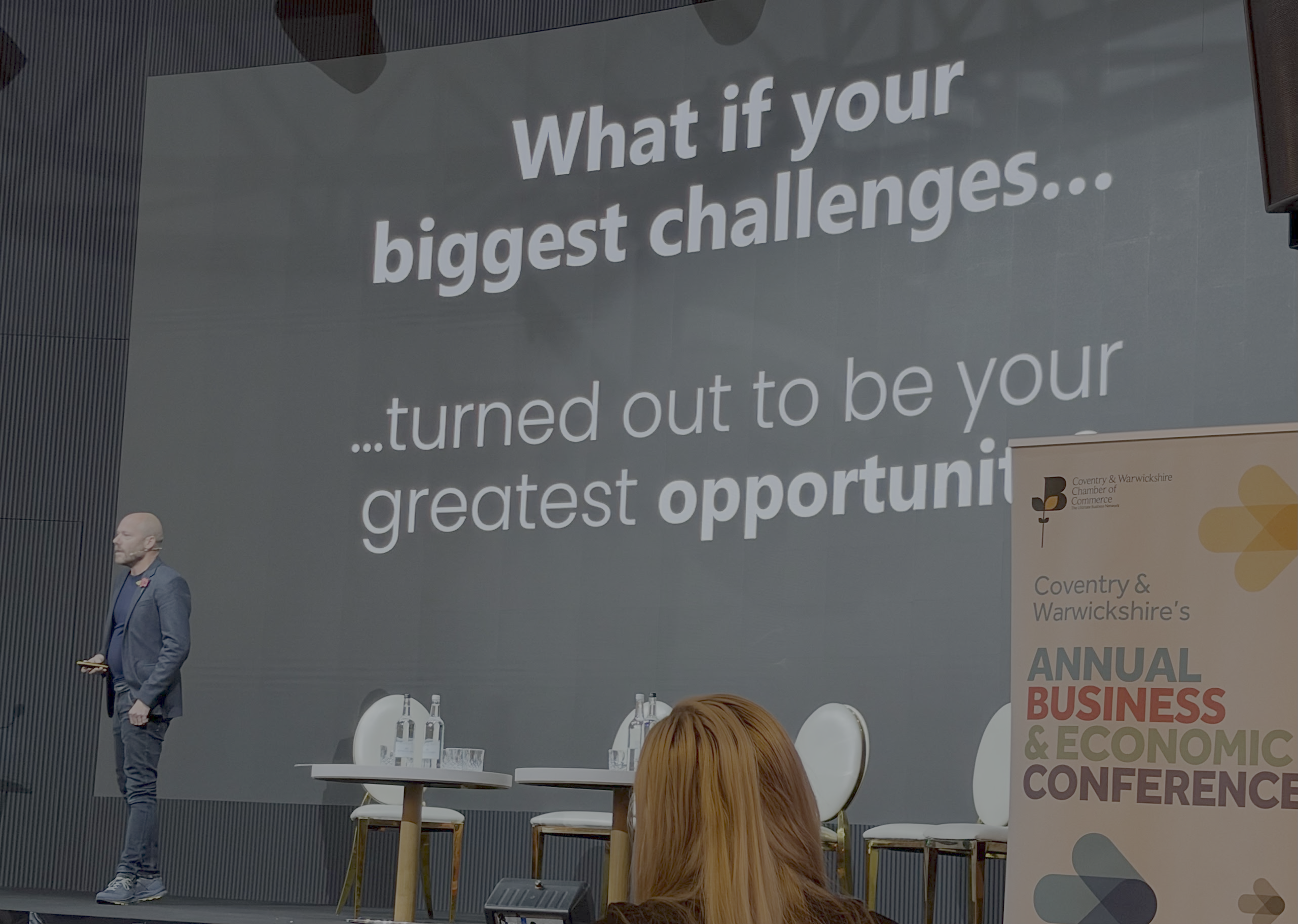
5. The Trunki Masterclass: Turning Existential Setbacks into Superpowers
To close the conference, keynote speaker Rob Law MBE, Founder and Former CEO of Trunki, took the stage to share the raw, unvarnished reality of building a globally recognised brand from scratch.
As someone who bootstrapped a public safety technology business from startup to a £20m+ exit, Rob’s opening line struck a massive chord with me: “The valuable lesson from my story isn’t how successful Trunki was; it’s actually how often it very nearly wasn’t.”
Rob structured his journey around three operational truths for when your business plan stops working: 1) Embrace setbacks, 2) Focus your energy on what matters, and 3) Embrace change.
Look at the obstacle course Rob had to navigate before Trunki became a household name:
- From Special Needs to Product Design:Growing up with undiagnosed dyslexia in a school special needs class where people assumed he wasn’t academic, Rob channelled his visual, hands-on creativity into studying product design at Northumbria University.
- Manufacturer Ping-Pong: After winning a national luggage design competition in the mid-90s by combining the internal capacity of blow-moulded adult suitcases with a child’s ride-on toy, Rob tried to license the product. He pitched British luggage giant Carlton in Croydon; they rejected him flatly, saying, “You’ve invented a toy, and we make luggage.” He pivoted to regional toy firm Mookie Toys, who took six months to reject him with the exact opposite verdict: “You’ve invented a piece of luggage; the Argos buyer won’t put it in the toy section.”
- The Licensing False Dawn: In 2003, he finally signed a global licensing deal with a startup toy company, expecting to sit on a beach collecting royalty cheques. Five years later, they had only managed to sell it to a single client in Saudi Arabia (branded for Fulla, the Middle Eastern equivalent of Barbie) before going into voluntary liquidation in 2005.
- The Positioning Pivot: Disillusioned with his corporate agency job designing products the world didn’t need (like an “eco-friendly” Unilever deodorant can that required six AAA batteries), Rob reclaimed his IP and quit his job in 2006. His breakthrough was strategic repositioning: if luggage buyers thought it was a toy, and toy buyers thought it was luggage, he would bypass both and position Trunki as a lifestyle brand for travelling parents.
- Surviving Dragons’ Den and the 2006 Hand Luggage Ban: Just months after his first container of Trixie and Terrance Trunkis landed at Avonmouth Docks in May 2006, Rob walked into the Dragons’ Den studio seeking £100,000 for 10% equity. In one of the most infamous segments in British television history, Theo Paphitis aggressively yanked the strap handle off a Trunki, Deborah Meaden declared the product’s integrity compromised, Peter Jones called his company “worthless”, and Rob had the commercial backbone to refuse Richard Farleigh’s predatory offer of £100k for 50% of his equity. Weeks later, in August 2006, a foiled terrorist plot led to an immediate, total ban on all cabin hand luggage across UK airports.
Any normal founder would have folded after being publicly humiliated in front of nine million BBC viewers and watching their core market (airport cabin luggage) outlawed overnight.
Instead, Rob treated every “no” and every external shock as free market research, re-engineered the strap clip, doubled down on his parenting lifestyle positioning, and scaled Trunki into a multi-million-pound global export phenomenon.
The Great Glenn: Building an Asset That Transcends the Noise
At Cameron & Cameron, our concept of The Great Glenn is a business that runs with such strategic clarity, leadership autonomy, and operational rhythm that external macroeconomic noise cannot derail it.
Walking out of the IXL Events Centre on Friday afternoon, the divide in the Midlands business community could not be clearer.
On one side, you have the 83%: founders who are exhausted by the treacle of rising NI, 96% refinery bottlenecks, and political uncertainty, who are hoarding cash, freezing decisions, and waiting for a magic wand from Westminster.
On the other side, you have the 17%: the operators who recognise that market friction is the ultimate filter. They are cleaning up their data “swamps” before deploying AI with ruthless 90-day ROI thresholds. They are pivoting from narrow sector labels to broad engineering and service capabilities like Unipart. They are diversifying their revenue streams like Coventry City FC so they are never beholden to a single Saturday result.

The Wee Hurdle: Your 3-Step Post-Conference Boardroom Audit
Do not let the insights from #CWBizConf26 sit in a notebook. Before your next leadership meeting, execute this three-step audit:
- The Lazy Cash & Pricing Audit: Look at your balance sheet and your Q1 2027 margin forecasts. With wage growth running at 4% and refined diesel costs staying elevated for the next 18 months, can your current gross margin absorb another shock, or do you need to re-engineer your pricing and deploy idle cash into margin-enhancing automation now?
- The 4-Pillar AI Swamp Check: List every AI tool your team is currently tinkering with. For each one, demand Professor Elena Gaura’s four pillars: Who is the named human Owner? What is the current cost Baseline? What is the RoI Threshold? And what is the financial Measure convertibility of the hours saved? If a tool doesn’t have all four, pause it or put it on a strict 90-day trial.
- The Unipart Capability Pivot: Write down how you describe your business in one sentence. If your description is tied entirely to a single customer sector (e.g., “We are an automotive tier-2 supplier”), rewrite it around your core technical or operational capability (e.g., “We are a precision material-joining and logistics partner”). Identify one adjacent growth sector (such as defence, infrastructure, or clean energy) where that capability is in high demand right now.
Whether you are planning to exit in three years or ten, your ultimate multiple will be determined by the decisions you make while the rest of the market is standing still. If you want to know exactly what your business is worth today (and which operational levers will add the most zeros to your endgame valuation) run your numbers through our Business Valuation Calculator and EBITDA Calculator, or book a virtual coffee with us to discuss how our Virtual Director service can help you cut through the treacle and scale with precision.